Keep your holiday budget available. Search Lisbon car rentals, check offers with a €0 security deposit and choose a payment method that works for you. Availability and conditions depend on the car and your dates.
Find no-deposit & no-credit-card optionsYour dates. Your total rental price.
Choose your dates in the catalogue above. Compare the full rental cost, the amount payable at pickup and the security deposit separately. No-deposit and no-credit-card conditions are not the same.
Lisbon Airport pickup: check your booking voucher for the exact meeting point. A terminal desk, a meet-and-greet service and a shuttle to an off-airport office are different arrangements. Choose the option that fits your arrival time.
Car Types Available in Lisbon
Compare the available categories for your dates. The catalogue shows current prices; the examples below describe vehicle types, not guaranteed models or deposit terms.
1. Why Rent a Car in Lisbon: The Best Way to See the Region
Lisbon rewards walking, but everything that makes a trip to Portugal memorable sits just outside it. Within an hour of the airport you can be standing on the westernmost point of continental Europe at Cabo da Roca, wandering the Romantic palaces of Sintra above the mist, swimming off the white sand of the Arrábida peninsula, or walking the complete medieval walls of Óbidos. In two and a half hours you reach the Algarve; in ninety minutes, the wine estates of the Alentejo. The capital is the front door — the car is what opens the rest of the house.
Public transport around Lisbon is genuinely good: the metro is quick, the Cascais and Sintra suburban trains are cheap and frequent, and long-distance buses reach most towns. But the trains only serve the two obvious day trips, and they leave you dependent on taxis at the far end — Cabo da Roca, the Arrábida beaches, the Comporta coast and the villages of the Alentejo have little or no service at all. A rental car is what turns a city break into a proper Portuguese road trip, and with the airport only 7 km from the centre you can be on the road twenty minutes after landing.
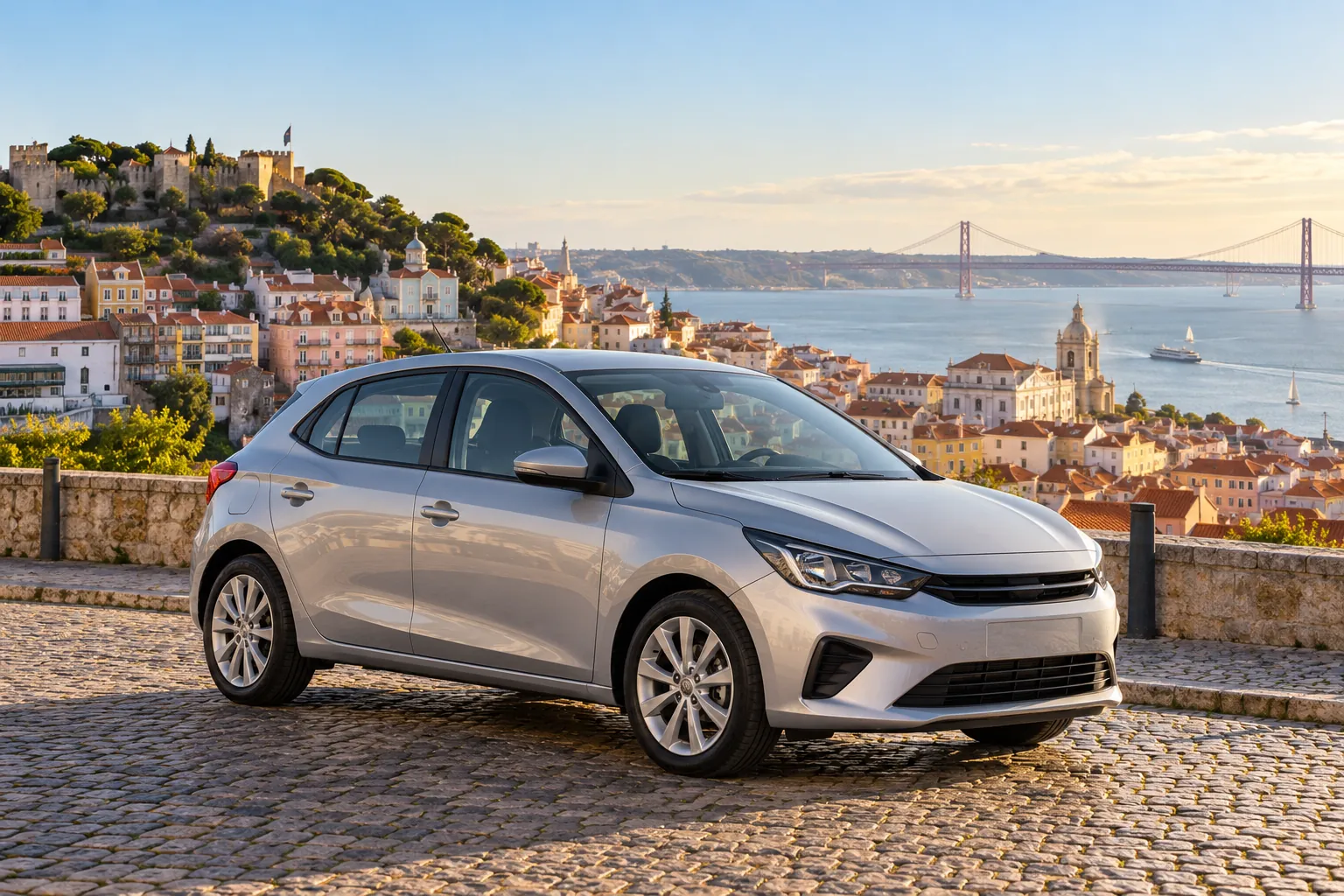
1.1 Popular Car Rental Destinations from Lisbon
2. Car rental Lisbon: no deposit and no credit card
2.1 Check the security deposit
For a no-deposit rental, the security deposit stated for the selected car must be €0. Check the car details before paying, including any separate fuel or toll guarantee. A low deposit is not zero deposit. Availability can change with your dates, vehicle and supplier.
2.2 Pay without a credit card
Use the “Without a credit card” filter when available, then read how the remaining balance and any deposit must be paid. Paying the booking advance online does not establish which cards are accepted at pickup. Check physical-card requirements and whether the card must be in the main driver’s name; do not assume cash or a virtual card will be accepted.
2.3 Deposit and insurance excess are different
The deposit is money held as security; the excess is the amount you may owe for covered damage. Zero-excess cover does not automatically remove a deposit or a credit-card requirement. Check exclusions, glass and tyre cover, mileage and additional drivers separately.
Find no-deposit & no-credit-card options
3. Free cancellation: check the terms before booking
Choose an offer with free cancellation if you need flexibility. Before paying, check the exact deadline, the applicable time zone and whether the booking advance is refunded. Do not assume every vehicle has a 24- or 48-hour cancellation window.
Keep your confirmation and follow the cancellation procedure stated there. Late cancellation, a no-show, an early return and a date change may have different conditions. Request changes before your pickup time.
4. Lisbon Airport car rental: pickup at LIS
Choose a car with airport collection available for your dates, then check the exact handover arrangement: terminal desk, meet-and-greet or shuttle to an off-airport office. Confirm pickup hours, any delivery charge and what to do if your flight is delayed.
Use your supplier’s return address and allow time for inspection, refuelling and any transfer to the departure terminal. Our Lisbon Airport car rental with no deposit and no credit card covers collection, payment checks and return planning.
Find no-deposit & no-credit-card options
5. Cheap car rental Lisbon: compare the total, not just the daily rate
Use the catalogue for prices on your exact dates. Compare the same pickup and return times, vehicle class and insurance. A lower daily rate is not necessarily a lower total rental cost.
| Check before paying | What to compare |
|---|---|
| Rental total | All rental days, taxes and required charges. |
| Pickup and extras | Airport delivery, out-of-hours service, additional driver and child seats. |
| Insurance | Included cover, optional protection, excess and exclusions. |
| Deposit and payment | The security hold is separate from the rental price; confirm its amount and payment method. |
| Cancellation | The free-cancellation deadline and any non-refundable amount. |
Check both the amount due now and the balance due at pickup. Compare a week using the exact return time, not seven times an advertised daily minimum. Fuel, tolls and optional services may be payable separately.
Find no-deposit & no-credit-card options
For a complete comparison method, see cheap car rental in Lisbon without a credit card: total prices, required extras and practical ways to save.
6. Car Rental Insurance in Lisbon: Excess, CDW and Full Cover
Insurance is the area where money is won or lost on a Lisbon rental. The motorways are excellent, but city parking is tight, kerbs are high, and cobbled streets and narrow village lanes make kerbed alloy wheels and mirror scrapes the most common minor-damage claims by a wide margin. Understanding the cover before you book saves both money and stress.
6.1 Types of Coverage
Third-Party Liability (TPL) — legally mandatory and always included; covers damage to other people and their property, not your own car.
Collision Damage Waiver (CDW) — limits your liability for damage to the rental car down to the excess amount. Standard on most rates.
Theft Protection (TP) — covers theft of the vehicle, usually bundled with CDW.
Super CDW / zero excess: read the coverage wording and exclusions. Glass, tyres and underbody are not automatically included. Reduced excess does not by itself remove the security deposit or change the accepted payment methods.
6.2 Photograph the Car at Pick-Up — Every Time
Walk around the car before you drive away. Photograph every panel, both bumpers, all four alloy wheels, both mirrors and the windscreen, and note any existing marks on the rental agreement. Kerb rash on alloys and folded-mirror scrapes are the most common disputes, especially with budget online brokers. Five minutes with your phone — with timestamped photos emailed to yourself — is your best protection against a charge for damage you did not cause.
7. Driving in Lisbon and Portugal: Rules, Roads and Rental Information
7.1 Documents Required to Rent and Drive
- Valid driving licence (held at least 1 year; minimum age usually 21)
- International Driving Permit — recommended for non-EU/EEA licence holders
- Passport or national ID card
- Booking confirmation / voucher
- Rental agreement and insurance papers — keep them in the car
7.2 Speed Limits in Portugal
- Towns and built-up areas: 50 km/h (often 30 km/h in residential zones)
- Conventional rural roads: 90 km/h
- Dual carriageways (vias reservadas): 100 km/h
- Motorways (A1, A2, A5, A8): 120 km/h, minimum 50 km/h
- Drivers who have held a licence under one year: 90 km/h maximum everywhere
Speed cameras and GNR checks are common on the A1, A2 and A5. Fines are issued on the spot to foreign-plated and rental vehicles, and rental companies pass on both the fine and an administration fee. Using a hand-held phone while driving is illegal. Seatbelts are compulsory for everyone, and children under 12 or under 1.35 m must use an appropriate child seat and sit in the back.
7.3 Blood Alcohol Limit
The legal limit is 0.05% BAC (0.25 mg/l in breath). For drivers in their first three years and for professional drivers it drops to 0.02% (0.10 mg/l) — stricter than in Spain. The simplest rule on a driving holiday is not to drink and drive at all.
7.4 Roads and Scenic Routes
A1 (Auto-estrada do Norte): the fast toll route to Coimbra and Porto. Excellent surface, roughly €25 in tolls to Porto.
A2 (Auto-estrada do Sul): Lisbon to the Algarve over the Ponte 25 de Abril, about €24 in tolls to Faro. Two and a half to three hours to the coast.
A5 / Marginal N6: two ways to Cascais — the A5 motorway is quick, the seafront Marginal is slower and far prettier.
N247 Sintra–Cabo da Roca–Guincho: the classic Lisbon drive. Cliffs, Atlantic surf and the westernmost point of continental Europe.
N379-1 Arrábida: a spectacular ridge road above turquoise coves between Sesimbra and Setúbal. Narrow, and access is restricted in high summer.
7.5 Caution: City Streets, Cobbles and Parking
Central Lisbon is the hardest driving on this list — steep gradients, cobbled surfaces that turn slippery in rain, blind one-way lanes, and trams that share the carriageway. Alfama, Bairro Alto and Mouraria are best not attempted in a rental at all. Parking on the street is metered by EMEL, colour-coded by zone and time-limited in the centre; underground car parks are the sane option at roughly €15–€25 per day. Do not leave anything visible in a parked car anywhere in the Lisbon area — opportunist break-ins are the most common problem visitors report.
7.6 Fuel and Tolls
Portuguese motorways are tolled, and this is the biggest practical difference from renting elsewhere in Iberia. Several routes are electronic-only with no cash booths at all, so every rental car comes fitted with a Via Verde transponder: you use the green lanes, and the tolls are charged to your card after the rental along with a service fee of about €1.50–€2.50 per day, usually capped at €20–€30. Typical toll costs are around €25 Lisbon–Porto on the A1 and €24 Lisbon–Faro on the A2; the A22 in the Algarve and the A25 have been free since January 2025. Fuel runs about €1.70–€1.85 per litre for petrol, dearer than Spain, so many drivers heading east fill up across the border. The standard rental fuel policy is full-to-full: you receive the car full and return it full, which is always cheaper than a prepaid tank.
8. Car Rental Companies in Lisbon: Local vs International
Compare the terms of each actual offer, not just whether the company is local or international. Neither label guarantees a lower total, no deposit or acceptance of a debit card. Prioritise the required payment method, deposit, pickup arrangement, cancellation terms and included cover.
Find no-deposit & no-credit-card options
9. Exploring Portugal: Choose the Right Rental Car
9.1 Match Your Car to Your Itinerary
Lisbon plus Sintra and Cascais only: a small economy car is perfect and by far the easiest to park.
Lisbon plus a few day trips: an economy or compact car is fine — the motorways do all the work.
Lisbon to the Algarve or the Alentejo: a compact is the comfort sweet spot for two to three hours on the A2 with luggage.
Full Portugal road trip, four adults: a compact SUV or estate with automatic transmission and full insurance.
9.2 Automatic vs Manual
Choose the transmission you drive confidently, then compare cars with enough space for your passengers and luggage. Automatic transmission and no-credit-card payment are separate requirements: check both in the selected offer. See our automatic car rental Lisbon with no deposit for the comparison and pickup checklist.
9.3 What Travellers Value Most
Visitors consistently highlight the same things about renting in Lisbon: the all-in price with no nasty excess, how close the airport is to everything, the quality of the motorways, and the sheer reach a car gives — three coastlines and two UNESCO towns inside a day's radius. The most common complaints — almost always with budget online brokers rather than established firms — relate to surprise excess charges, off-airport shuttle waits and disputes over pre-existing damage. All three are avoidable: book with a reputable all-in supplier, check whether pick-up is in-terminal, and photograph the car.
10. Beyond Lisbon: One-Way Rentals and Driving into Spain
Lisbon is a natural starting point rather than a destination in itself. One-way rentals to Porto (~300 km, 3 hours on the A1) and Faro (~280 km, 2 hr 45 on the A2) are widely available and let you drive the country end to end without doubling back; expect a one-way fee that varies by supplier and season. Spain is closer than most visitors expect — Badajoz is 2 hr 30, Seville 4 hr 30 — but taking a Portuguese rental across the border has rules attached.
10.1 What You Need to Drive into Spain or Drop Off Elsewhere
- Declare cross-border travel at the time of booking — not at the desk on arrival
- Most suppliers require written authorisation and charge a cross-border fee; some restrict it by car class
- Confirm that insurance and roadside assistance still apply in Spain
- Driving into Spain undeclared can void your cover entirely
- Agree the one-way fee for Porto or Faro drop-off in writing before you pay
- Remember Spanish fuel is cheaper — fill up after the border, not before returning
11. Top 10 Car Rental Mistakes to Avoid in Lisbon
- Ignoring the excess — a cheap headline rate can hide a €1,500 excess. Check it before you book.
- Not photographing the car at pick-up — alloy kerb rash is the number-one dispute. Document everything.
- Not understanding the tolls — several motorways are electronic-only. Take the Via Verde transponder; without it you risk fines.
- Driving into the historic centre — Alfama and Bairro Alto are steep, cobbled, one-way and effectively parking-free.
- Booking an automatic too late — Portugal's automatic fleet is small and sells out months ahead in summer.
- Falling for prepaid "full-to-empty" fuel — full-to-full is almost always cheaper.
- Booking an off-airport broker by accident — the shuttle can add 30 minutes each way. Check the pick-up type.
- Leaving bags visible in a parked car — break-ins at Sintra, Cascais and Guincho car parks are common.
- Taking the car into Spain undeclared — it can void your insurance. Ask when booking.
- Assuming debit cards are accepted: check the selected car’s payment conditions before booking, even if you pay the advance online.